
Last Updated on September 19, 2026
This VPN Works with BBC and you Can Try it for Free
If you’ve ever tried to watch any British television from abroad, you’re probably aware of the classic solution: just connect to a VPN server in the UK, open BBC iPlayer, and let the site see the UK IP address of the server. Simple and in theory, that’s still how it works except mostly in real life it doesn’t any more.
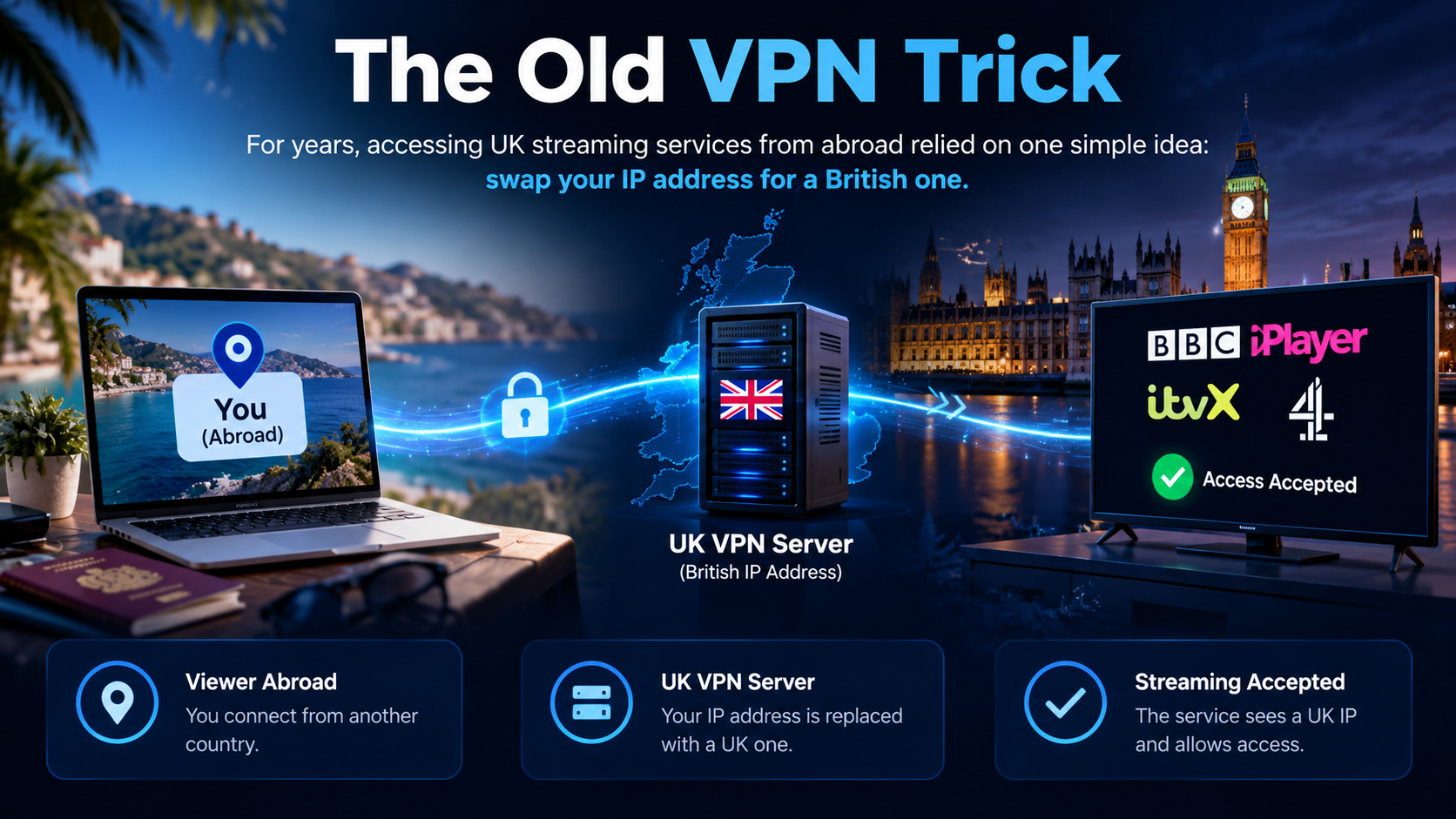
It’s just that these days, a UK IP address from a standard VPN isn’t always enough anymore. It’s a shame and unfortunately more and more people are discovering this to their cost after shelling out for some VPN that used to work perfectly well with all the UK TV channels.
Millions of people — holidaymakers, expats, and lifelong British TV fans who’ve never set foot in Britain — have done this for years. So why is it quietly failing now? The answer isn’t encryption, and it isn’t some sort of fancy VPN detection software. It’s just the IP address itself, and the pool of users sharing it.
Unblocking BBC with a VPN Demo – 2026
So firstly a quick demo – before I explain the ins and outs of this – I want to show a VPN that still works perfectly well for a variety of reasons – here’s the video on Youtube.
If you want to try it for yourself – it’s pretty easy to use (perhaps a little less user friendly that a standard VPN) but not much and what’s more it’s one of the very few (if only) VPNs that has a Free trial available. Now it only works with the standard payment methods not their high privacy options (Crypto and cash) but it’s genuine and I’ve tested this. Sign up for an account and select the 7 day trial option – then you can literally cancel the subscription from the same screen straight away and it will work perfectly. Perhaps though give it a try and cancel before the seven days as it works well and is genuinely a great product.
NYM VPN Free Trial Offer
How Streaming services actually spot a VPN
Conventional VPNs are fairly easy to identify. A commercial provider like Surfshark, Proton or IPVanish runs thousands of customers through the same server, all sharing the same IP address.
Those servers also sit inside large commercial datacenters that almost every website already knows about. It’s like having a postal address on a trading estate, you know it belongs to a business as there are no real houses there. All the streaming companies can easily cross-reference VPN address ranges, hosting providers, and of course traffic volumes to identify the vast majority of VPN servers being used to bypass their geo-blocks — and once an IP address is flagged, it goes on a central list and stops working for everyone.
So you can connect to a London VPN server, get a perfectly genuine UK IP, and still be blocked. That’s what happens on most services today. The giveaway isn’t the software on your machine or the encryption in transit — it’s the shared, datacenter-hosted address at the other end.
A different architecture: Nym’s independent exit nodes
NymVPN takes a structurally different approach which is actually quite simle but very effective. Instead of one company owning a vast array of easily identifiable datacenter servers, it runs a decentralized network of independently operated nodes. So these are run and owned by a huge selection of different people, the traffic is still encrypted and safe but the servers are not directly controlled by Nym.
In Fast Mode which is the only mode that is suitable for streaming video, traffic travels through a separate entry and exit gateways — and you can choose a UK exit node before you connect.
Here’s what makes that interesting. These exit nodes aren’t a single collection of hundreds of servers under one brand. They’re run by ordinary independent operators — individuals, universities, colleges — that blend into the wider internet rather than broadcasting a massive, single-operator footprint. Which is why they’re difficult to detect – sure many of them are linked to datacentres but many are not.
And crucially, some UK nodes are actually registered to residential IP addresses. Those are extremely rare and expensive in the proxy and VPN world, and they’re effectively invisible to streaming detection, because they don’t look like a VPN at all.
The result is a far more varied pool of exit addresses than any single-provider VPN can offer.
The test: does it actually stream?
Rather than just claim it, the video puts it to the test — spoiler, this is the demo part, and it’s worth watching the streamed evidence yourself – check out the video or grab the free trial anc check for yourself.
Connecting through a London exit node, BBC iPlayer streams without a block at all. Switching across to ITVX — including a 70s documentary worth watching — it comes through again, adverts and all. The hypothesis holds in practice, not just in theory. ITVX is actually a better test than BBC iPlayer as it seems to be even more aggresively blocking VPNs than the BBC.
The Honest Caveats
NymVPN is not an invisible VPN, and it’s worth being straight about the limits. The BBC still sees an IP address at the end of the connection, just like with any other VPN, and that specific address could still be recognised or blocked. I guess a lot will depend on the success of NYM attracting new operators to the project – if it can get lots of normal home users and colleges to the lists then they;re going to be very difficult to block.
And remember Nym also isn’t designed for raw speed — privacy is its primary goal, and the mixnet mode that you will see that provides the strongest protection isn’t suitable for streaming anyway althogu you could potentially use it to download and stream offline.
What you’re relying on is a much larger and more varied pool of addresses, so the exit you connect through matters. If one is blocked, try another.
Which is why this is a practical verdict rather than a permanent one: NymVPN, despite it not being the product’s stated goal, is currently one of the better options for accessing BBC iPlayer and UK TV. And with a free trial, you can test the exit nodes for yourself before believing anyone’s word.